 Donate


Update
A War That Redefines Trauma Care
“It’s one thing to read about trauma care — and another to learn it from surgeons who’ve done it for wounded soldiers.”
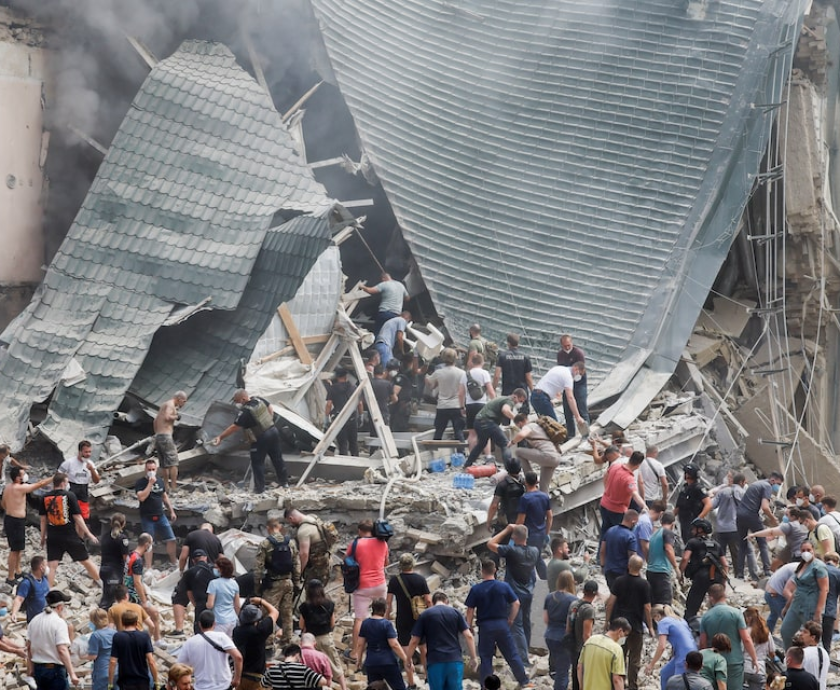
For over three years, Ukraine has faced unrelenting Russian aggression — missile strikes, artillery shelling, and drone attacks that have turned hospitals, roads, and entire communities into battle zones.
Doctors across the country are working around the clock to treat the wounded, often under extraordinary conditions and with limited resources.
Sadly, the nature of injuries in Ukraine has changed dramatically.
According to recent analyses, Ukraine has become the first place in history where drones dominate the battlefield on an industrial scale, causing over a quarter of all combat deaths (26.3%). These attacks come from above, striking the most vulnerable areas — the head, neck, groin, armpits, and ears — bypassing traditional body armor. Soldiers and civilians arrive withmultiple injuries, blast trauma, burns, and hearing loss.

In Ukraine, evacuation is slow and dangerous. Drones circle overhead, artillery targets convoys, and frontline medics must often wait until nightfall or risk being hit themselves.
During the Second World War, the so-called “Golden Hour” — the critical window for saving lives — was actually six hours long. That was the goal for evacuation from the battlefield to a surgical table. Today in Ukraine, even that is often impossible. This is medicine under fire — a return to trench warfare, with doctors treating patients in makeshift shelters, stabilization points, and under the constant threat of renewed attack.
As a result, many patients reach hospitals too late, when infection, sepsis, and amputations are already unavoidable. Yet Ukrainian medical teams refuse to give up. They adapt, they innovate, and they keep learning — because every skill mastered means another life that can be pulled back from the brink.
The Response: MedGlobal’s Surgical Skills Lab

To meet this urgent need for new and improved surgical skills, MedGlobal organized a Surgical Skills Lab from September 29 to October 3, 2025, at Vinnytsia National Pyrohov Memorial Medical University.
The training brought together 50 Ukrainian general surgeons and traumatologists for an intensive, hands-on course designed specifically for treating war-related injuries.
The program began with a day of theoretical lectures on mine-blast and shrapnel wounds, vascular trauma, burns, hemorrhagic shock, and modern approaches to damage control surgery and resuscitation.
Doctors also learned to use ultrasound diagnostics — including FAST (Focused Assessment with Sonography for Trauma) and lung examinations — to detect internal injuries faster and more accurately in the field.
During the next three days, participants rotated through practical modules on biological models, practicing critical, lifesaving procedures under the supervision of six MedGlobal volunteer trauma surgeons from the United States. With a 1:5 instructor-to participant ratio, each doctor received individual mentorship while learning:
- Surgical airway management
- Thoracotomy and access to the thoracic aorta
- Control and reconstruction of the heart, lungs, liver, and kidneys
- Pringle, Mattox, and Cattell-Braasch maneuvers
- Repair of the trachea, esophagus, and ureter
- Placement of vascular shunts and grafts
These are the procedures that save lives when every second counts — on the battlefield and in hospital trauma bays alike.
The Impact: Courage, Skill, and Solidarity
“We treat soldiers with mine-blast and gunshot injuries every week,”
The participants left the training with new skills, confidence, and hope.
“We treat soldiers with mine-blast and gunshot injuries every week,” said Dr. Mykhailo Mamchur, orthopedic trauma surgeon. “The training on wound care and fasciotomy will directly improve outcomes for the wounded we receive.”
“After years of only online learning, meeting experts with decades of surgical experience was priceless,” shared Dr. Andrii Formanchuk, abdominal surgeon and transplantologist.
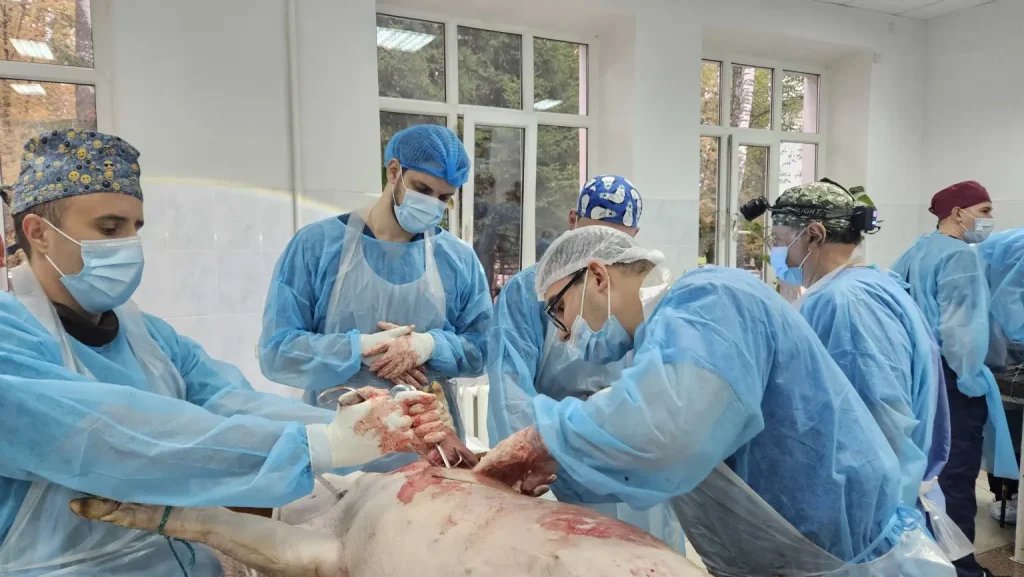
“I will use these skills to treat both soldiers and civilians after shrapnel blast injuries.” For frontline medics like Vlada, the course was not just about skills — it was about survival and solidarity.
“We are the first to see these wounds,” she said. “Understanding how to stabilize a patient correctly means they can reach the hospital alive. This training gives us that knowledge — and the confidence to act fast.”
Dr. Andrii Hrytsyshyn, a military doctor, added:
“Our mentors showed us the essentials every military surgeon must know. Their calmness and professionalism remind us that even amid chaos, medicine brings hope.”
Even medical students are preparing to take on the challenge.
“Today I practiced chest decompression and sutures on the heart,” said Sofiya, a sixth-year student. “I know these skills can save lives. I only wish there were more trainings like this.”
Why It Matters

As Russia’s attacks continue to wound thousands of Ukrainians, the ability to deliver fast, expert trauma care has never been more crucial.
Each MedGlobal training strengthens Ukraine’s healthcare system — empowering doctors to respond decisively and save lives, even in the harshest conditions.
As Dr. Michael Samotowka, MedGlobal Board Member and Volunteer, and the Resiliency Medical Mission in Trauma Surgery team leader said:
“What Ukrainian doctors face today will shape the future of trauma medicine worldwide.”
Stand with Ukraine’s Healers
Behind every surgery and every recovery is courage — and your support.
Every donation helps bring more international experts to Ukraine, purchase vital surgical tools, and train more doctors working under fire.
Donate. Share. Volunteer.
Stand with Ukraine’s healers — because every trained doctor means another life saved, another family kept whole, and another act of resistance against destruction.
Donate today: https://medglobal.org/donate/