 Donate
What We Couldn’t See: Lujain’s Story of Healing
After her father was killed, Lujain’s declining appetite and weight were only part of what she was experiencing. Coordinated nutrition and mental health care helped her begin to recover.
Deir Al Balah, Gaza
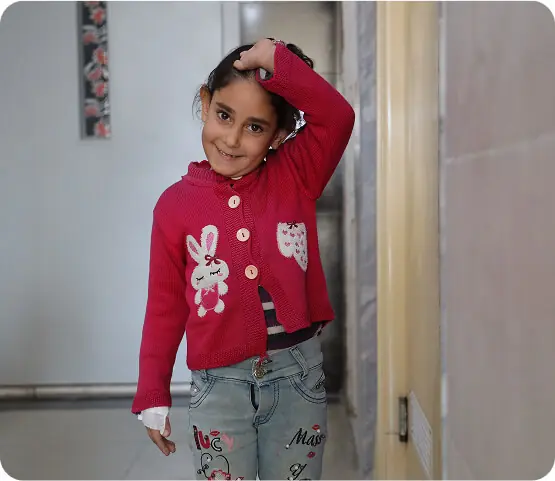
It started with a request. Lujain, a seven-year-old girl in Gaza, asked for a meal. Not just any meal, but a food she had not asked for in months.
In most households this would pass unnoticed. For the two health care workers following her care, it was the sign they had been waiting for. “She began asking for meals she hadn’t asked for before,” one of them recalls. “This gave me relief.”
To understand why a request for food could bring relief, it helps to go back to the point where eating stopped being simple.
When eating became part of a larger problem
Lujain’s father was killed in the conflict. In the period that followed, she experienced severe trauma, and its effects reached well beyond her emotional state.
“This caused a loss of appetite, a complex mental state, anemia, and severe weight loss.”
Saba Al-Najjar, Nutrition Officer
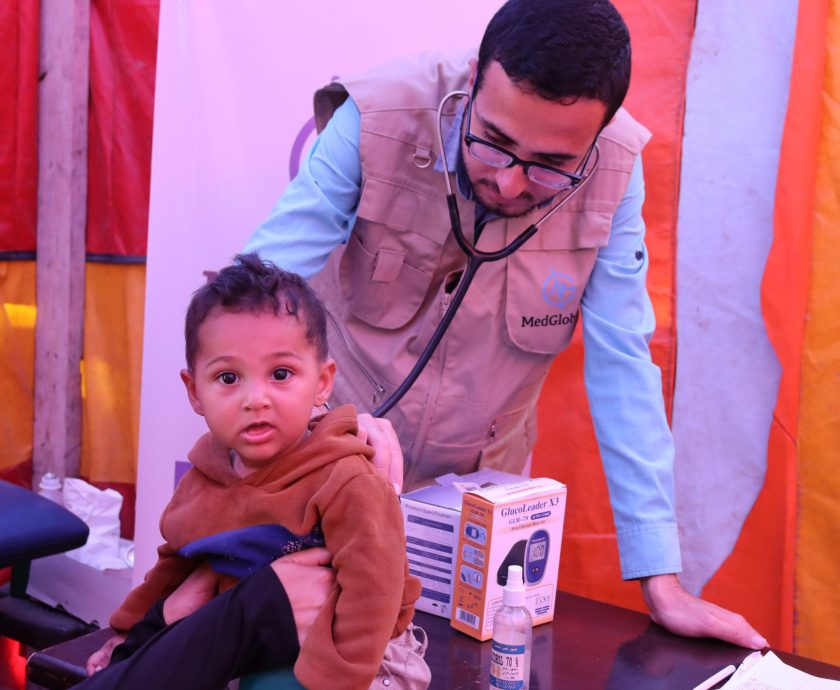
“She had severe trauma after her father was killed,” says Saba Al-Najjar, a nutrition officer with MedGlobal in Gaza. “This caused a loss of appetite, a complex mental state, anemia, and severe weight loss.”
Anemia is a condition in which the blood carries too little oxygen. It leaves a child tired and struggling to focus. At school, Lujain’s concentration slipped. At home, and in daily activities, she withdrew.
Her mother saw it happening. “I noticed her mental and dietary health declining,” she says. She was told to bring Lujain to MedGlobal, where the family, displaced from their home and now living in a school, could see specialists.
Each of Lujain’s symptoms could be recorded on its own. Weight on a scale. Hemoglobin on a lab result. A teacher’s note about attention. Taken one at a time, they pointed to a nutritional problem with a nutritional solution. Taken together, they described something more.
Looking beyond nutrition
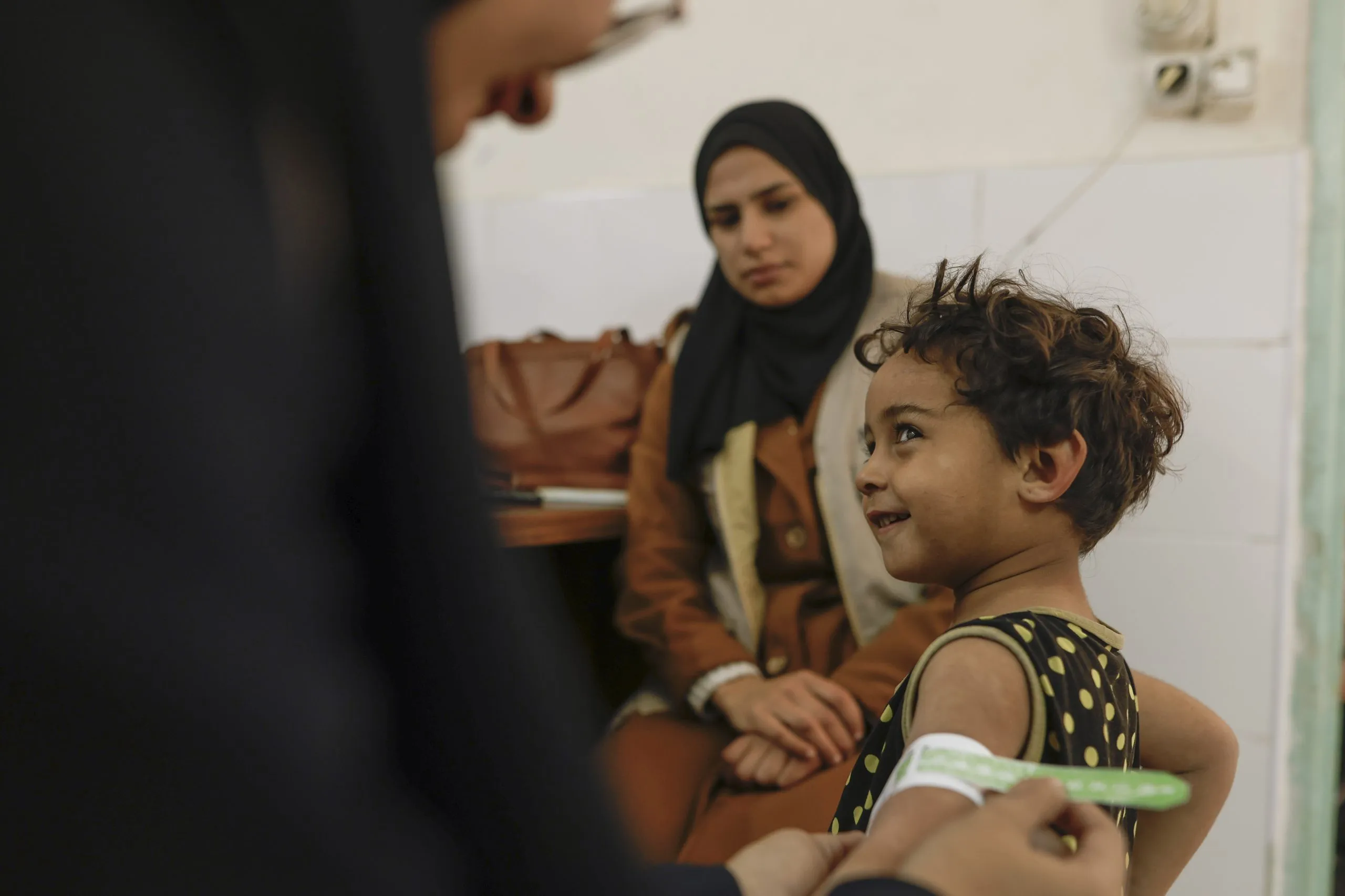
Saba met Lujain three months before this story was recorded. Her assessment established the visible clinical picture: a child who was underweight, anemic, and not eating enough.
“We cared for her, forming a partnership with the therapist to address both her mental and dietary needs.”
Saba Al-Najjar, Nutrition Officer
Nutritional care was necessary, and Saba provided it. She monitored Lujain’s intake and weight and supported her with the vitamins she needed. But food and supplements alone would not reach what was driving the decline. A child who stops wanting to eat after the death of a parent is not only short of calories. The loss of appetite, the loss of weight, and the loss of interest in school had arrived together, and they had a shared origin.
“We treated Lujain with love and respect,” Saba says. “We cared for her, forming a partnership with the therapist to address both her mental and dietary needs.”
Two specialties, one plan of care
That therapist is Islam Al-Qernawi, a mental health and psychosocial support (MHPSS) worker. MHPSS is the term humanitarian programs use for counseling and structured activities that help people process distress, often in places where formal therapy is out of reach.
“We helped her process all she went through using drawings, reading stories, writing her own tales, poetry, and group support sessions.”
Islam Al-Qernawi, MHPSS Worker
With Lujain, Islam’s work took forms a child could step into. “We helped her process all she went through using drawings, reading stories, writing her own tales, poetry, and group support sessions,” she says.
None of these is a treatment on its own. Together, they gave Lujain ways to express what had happened to her that did not depend on being asked direct questions about it. Over time, the team worked to shift the dark thoughts Lujain carried about her father’s death, and about the violence surrounding it, toward better ones. Her mother was part of that work, supporting her daughter at home between sessions. “They advised me to follow up,” her mother says, and she did.
Meanwhile, Saba continued to track Lujain’s nutrition and physical recovery. The two did not work in sequence, with one handing off to the other. They worked in parallel, sharing what they were seeing, so that progress in one area could be read in light of the other.
Recovery in small signs
Over three months, the changes were gradual and specific.
Lujain began asking for meals. Her weight, in Saba’s words, “improved a lot” with treatment and the vitamins she needed. In sessions, she became more engaged. “She participates and responds more,” the team observed. “She follows rules and focuses more at school.”
None of these signs belongs to a single specialty. A request for food is a nutritional event and a psychological one. Improved concentration reflects a body receiving what it needs and a mind less occupied by grief. This is why the moment Lujain asked for a meal carried such weight for the people caring for her. It was evidence that the two arcs of her recovery were moving together.
Why integrated care matters
Lujain is one child, and her experience should not be read as a description of every child in Gaza. But her case illustrates something clinicians in conflict settings encounter often, and that health services are not always organized to handle: physical and psychological needs that arrive as a single problem, presenting first through whichever symptom is easiest to measure.
What made the difference in Lujain’s care was not a new tool or technique. It was two health care workers recognizing that what each of them was seeing formed part of the same picture, and coordinating their care around it. A nutrition officer who notices that a child’s weight loss began after a bereavement has a colleague to turn to, and that colleague works alongside her rather than after her.
What changed
Recovery is a process, not an event. Lujain and her family are still displaced, living in a school. That has not changed. What has changed is that she eats, she draws and writes, she takes part, and she can concentrate in class.
“Lujain’s case is a true success story for us,” Saba says. Three months ago, her decline was recorded in numbers that told only part of the story. The rest was what the numbers could not show, and what two people caring for her chose to see together.
MedGlobal in Gaza
MedGlobal is an international medical humanitarian organization that delivers emergency care, strengthens health systems, and builds local capacity in crisis-affected and underserved communities. Around 95 percent of its program delivery is carried out by local staff, working alongside national health workers and ministries of health.
In Gaza, where hospitals are non-functional or only partially functional, MedGlobal supports two maternity hospitals and provides a high volume of sexual and reproductive health services. Mental health and psychosocial support is treated as a core part of that work rather than an added service: it is integrated into medical points and primary care, and delivered through dedicated programs for children, adolescents, and conflict-affected families. Lujain’s care took place within this model, where a nutrition officer and a mental health worker could reach the same child through the same door.
Care like this depends on people who choose to stand with families in Gaza. Your support helps keep nutrition and mental health services running for children like Lujain. Learn more about how you can support our work in Gaza.